Why Do Strategies Fail to Turn Into Measurable Outcomes?
Strategies fail to turn into measurable outcomes when they are not translated into clear action, aligned across teams, reinforced through leadership, and embedded into day-to-day behavior.
Most organizations are not short of strategy. They are short of alignment between intent, execution, and behavior.
Why organizations struggle
At senior levels, strategy often appears clear. Objectives are defined, priorities are agreed, and plans are created.
The problem emerges as strategy moves through the organization.
It becomes interpreted, simplified, reframed, or disconnected from daily work.
The result is an organization that is active, but not aligned.
Visual: simplified “Strategy Gap”
Strategy → Translation → Execution → Measured → Outcomes
Caption: Where alignment breaks down and value is lost.
The Strategy Execution Chain
Strategy only creates value when it moves through a deliberate chain:
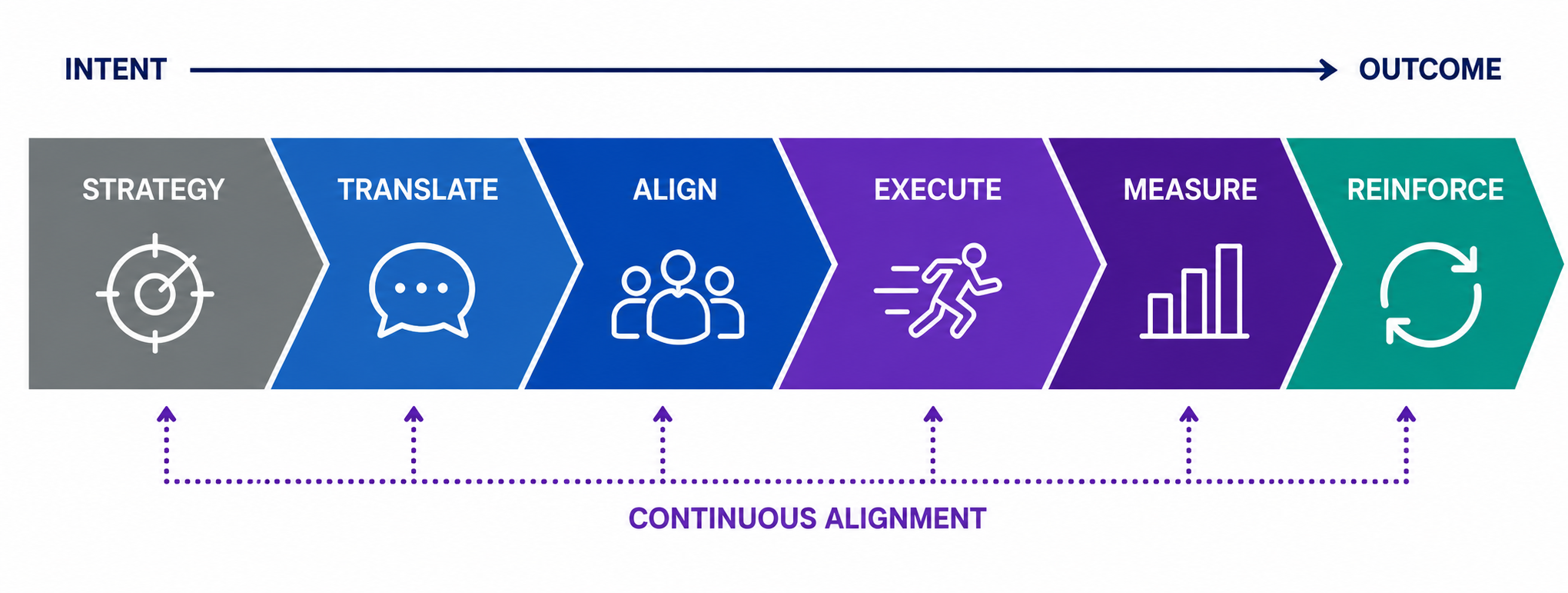
Each step matters.
Strategy defines direction.
Translate turns intent into practical expectations.
Align connects teams, priorities, ownership, and resources.
Execute turns direction into coordinated action.
Measure tracks outcomes and behavior, not just activity.
Reinforce sustains the behaviors that produce results.
Visual: simplified horizontal chain using your gradient.
Where execution fails
Execution fails when:
- Strategy is not translated into role-specific expectations
- Teams optimize for local priorities
- Ownership is unclear
- Measurement focuses on activity rather than outcomes
- Leadership communication is inconsistent
- Behavior is not reinforced over time
This is why execution issues are often really alignment issues.
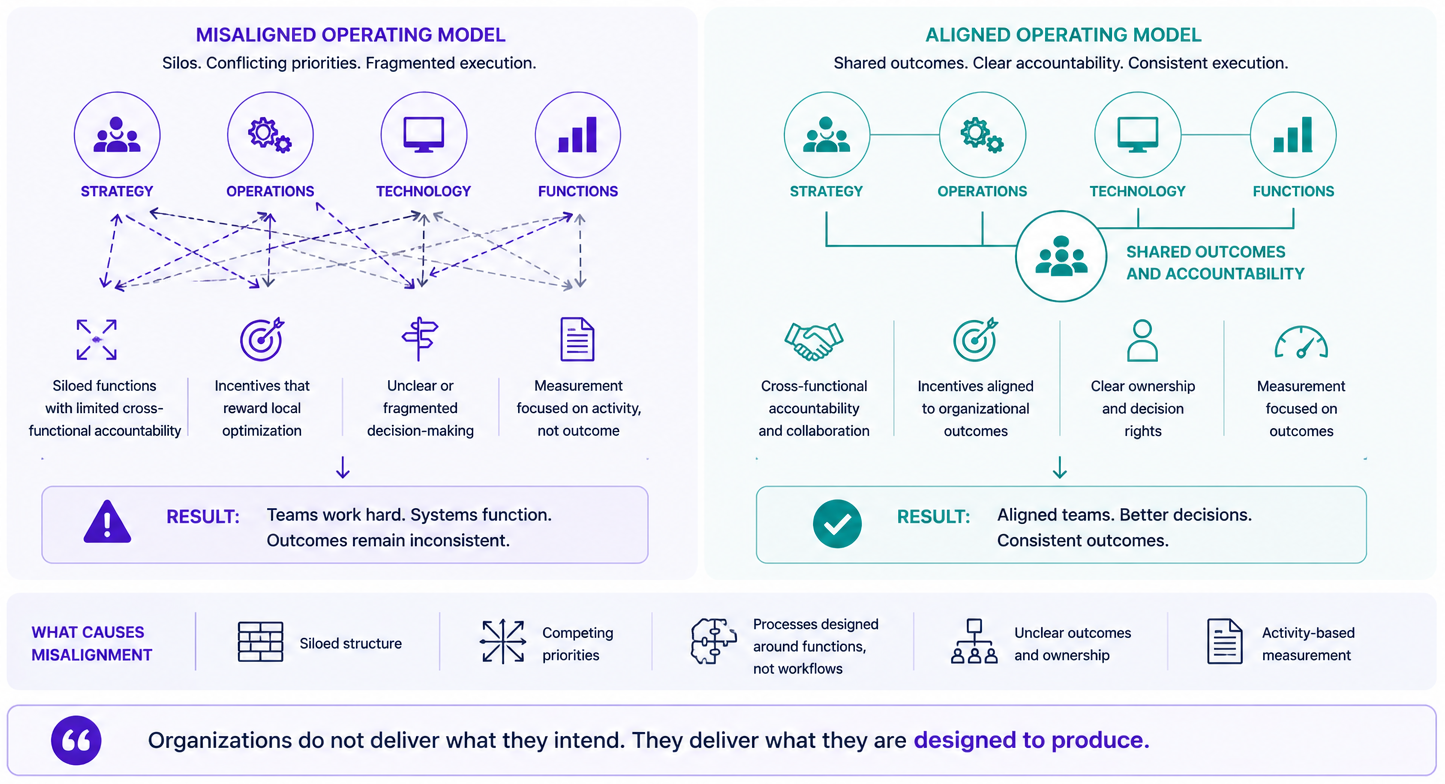
Why operating model matters
Strategy is delivered through the operating model.
If the operating model is misaligned, execution will fail regardless of strategic intent.
Organizations do not deliver what they intend. They deliver what they are designed to produce.
Leadership as the alignment layer
Alignment does not happen naturally.
It must be created, communicated, and reinforced.
Leadership creates alignment through clarity, consistency, and reinforcement.
The role of technology and AI
Technology can support communication, workflow integration, measurement, and feedback.
AI can help translate complex information into guidance, support decision-making, and identify deviations in performance.
But technology does not create alignment.
It can only enable alignment when strategy, ownership, workflows, and behavior are already deliberately designed.
Practical takeaway
To turn strategy into outcomes, organizations need to:
- translate strategy into practical action
- align teams around shared outcomes
- define ownership and decision rights
- measure behavior and outcomes, not just activity
- reinforce effective ways of working continuously
The goal is not more activity.
The goal is aligned, repeated behavior that delivers measurable outcomes.
Go deeper...
This article is based on the full paper:
From Strategy to Execution: Designing Organizations That Consistently Deliver Outcomes
Download the full paper